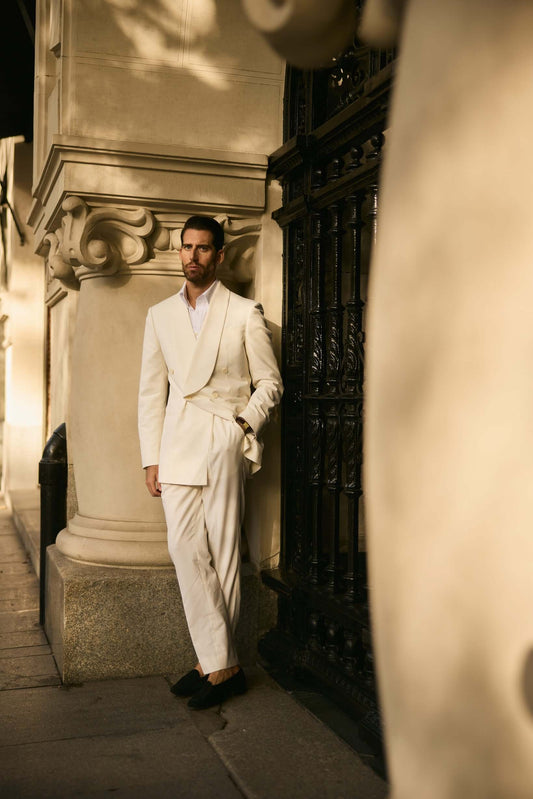

Suit Trouser Break Guide: No Break, Half Break, Full Break
Last modified:Share
The "break" - the point where a trouser hem meets the top of the shoe, and whether fabric folds over that point - is among the most overlooked details in how a suit reads as a whole, and it's also one of the more straightforward fixes when it's wrong.
Quick answer: There are three standard trouser break options - no break (hem sits exactly at the top of the shoe, no folding fabric, the most modern and cropped look), half break (a single, slight fold of fabric at the front of the leg, the most versatile and forgiving option), and full break (a more substantial fold of fabric over the shoe, a traditional, relaxed look now increasingly rare outside conservative dressing). Shorter builds generally look leanest in no break or half break; taller builds have more room to carry a full break without it reading as sloppy.
Key Takeaways
- No break creates the most modern, tailored look but leaves zero margin for error in trouser length.
- Half break is the safest, most broadly flattering default for the widest range of builds and settings.
- Full break is a traditional, increasingly rare look best suited to taller frames with room to carry the extra fabric.
- Break length should be chosen with the wearer's height and leg proportions in mind, not selected purely on style trend.
No Break: Modern and Cropped
"No break" describes a trouser hem that sits precisely at the top of the shoe, with no fabric folding over the shoe at all - a clean, unbroken line from knee to shoe. This is the most modern-reading option among the three, and it's the look most closely associated with contemporary, fashion-forward tailoring, since it photographs cleanly and creates the leanest possible visual line down the leg.
The tradeoff is precision. Because there's no fold to absorb minor length inconsistencies, a no-break trouser leaves essentially no margin for error - even a small miscalculation in hem length becomes immediately visible, either riding up above the shoe (reading as too short) or bunching slightly (reading as an accidental half break rather than an intentional no-break line). This makes no break a style that benefits specifically from precise, individually measured hemming rather than a standard length pulled from a size chart.
Half Break: The Versatile Middle Ground
A half break allows a single, slight fold of fabric at the front of the trouser leg, just above the shoe. This is widely considered the safest and most broadly flattering option among the three, precisely because it splits the difference between no break's precision requirements and full break's more substantial, traditional drape.
Half break's forgiving nature - it doesn't demand the exact precision no break requires, while still reading as current and tailored rather than dated - is why it functions as the reasonable default for most guys building a versatile suit meant to work across a range of settings and body proportions.
Full Break: Traditional and Relaxed
A full break allows considerably more fabric to fold over the top of the shoe, a look that was the dominant standard through most of the 20th century before shorter breaks became fashionable. Today, full break reads as distinctly traditional and relaxed, and it's become increasingly rare outside of conservative, classic-leaning dressing contexts.
This traditional character isn't a flaw - for anyone deliberately building toward a more old-world, classic aesthetic, full break is an intentional and coherent choice rather than an outdated mistake. It's simply a less common default in contemporary tailoring than it once was.
Which Break Actually Suits Your Height
Break length interacts meaningfully with height and leg proportion. Shorter builds generally read as leaner and more elongated in no break or half break, since minimizing fabric pooling at the ankle removes visual interruption to the leg's line. Taller builds have considerably more visual room to carry a full break's extra fabric without it reading as sloppy or ill-fitting, since the additional length has proportionally less visual impact on a longer leg.
This is a case where a style choice and a fit consideration overlap directly - the "right" break isn't purely a matter of current trend, but a genuine interaction between the style choice and individual body proportions.
Frequently Asked Questions
Does trouser break apply to both formal trousers and casual chinos?
The same principle applies to any tailored trouser, though the specific break chosen might differ by context - no break or half break tends to suit both formal and casual tailored trousers well, while full break is more strongly associated with traditional formal trousers specifically.
Can trouser break be adjusted after a suit is purchased?
Yes, generally - hemming trousers to adjust break length is one of the more common and straightforward suit alterations, provided there's enough fabric length available to work with. This makes break a relatively easy detail to correct compared to something like lapel width, which typically can't be altered after construction.
Is no break appropriate for a formal or black-tie event?
Yes - no break has become widely accepted even in formal contexts as tailoring trends have shifted toward cleaner, more precise lines. It's no longer considered exclusively a casual or fashion-forward choice; it works across most formality levels provided the trouser hem is genuinely precise.
The Bottom Line
Half break is the safe, versatile default for most builds and most settings. No break offers the sharpest, most modern line but demands precise hemming; full break is a traditional, relaxed look best suited to taller frames with the proportional room to carry it well.
Getting your trousers hemmed to the exact break you want starts with a fit built around you - explore our custom trousers and custom slacks .