
Wedding Guest Attire for Men: What to Wear When You're Not the Groom
Last modified:Share
Dressing as a wedding guest carries a specific, often unstated rule that governs everything else: look genuinely sharp, but never risk drawing attention away from the couple or the wedding party. Here's how to read an invitation correctly and land exactly where it's asking.
Quick Answer: Wedding guest attire should match the stated dress code on the invitation as the floor, not a rough suggestion. When the wording is ambiguous, leaning slightly more formal is the safer error than leaning too casual. Avoid all-white, which can read as competing with the bride, and outside black-tie events, avoid all-black for daytime or outdoor weddings. Fabric weight and color should shift with both time of day—daytime lighter, evening darker—and season, regardless of the stated formality level.
Key Takeaways
- Treat the invitation's stated dress code as a minimum expectation, and default toward slightly overdressed when it's unclear.
- Avoid all-white outfits and, for daytime or outdoor weddings specifically, avoid all-black unless the event is explicitly black tie.
- Daytime weddings call for lighter colors and fabrics; evening weddings shift toward darker suiting regardless of season.
- Never wear an actual tuxedo unless the invitation specifically states black tie—it risks visually competing with the wedding party.
Match the Dress Code, Don't Guess It
The majority of wedding invitations state a dress code directly—black tie, formal, cocktail, semi-formal, or casual—and that stated wording should be treated as a floor, not merely a loose suggestion open to individual interpretation. Wedding guests who underdress relative to the stated code stand out for the wrong reason, in a setting specifically built around a couple who've likely thought carefully about the atmosphere they want.
When an invitation's wording is genuinely ambiguous—"dressy casual," for instance, or no dress code specified at all—the safer error is leaning slightly more formal rather than less. Overdressing modestly at a wedding rarely draws negative attention; visibly underdressing does. See our formal vs. semi-formal guide if the invitation wording itself is the source of confusion.
Color Rules Every Guest Should Know
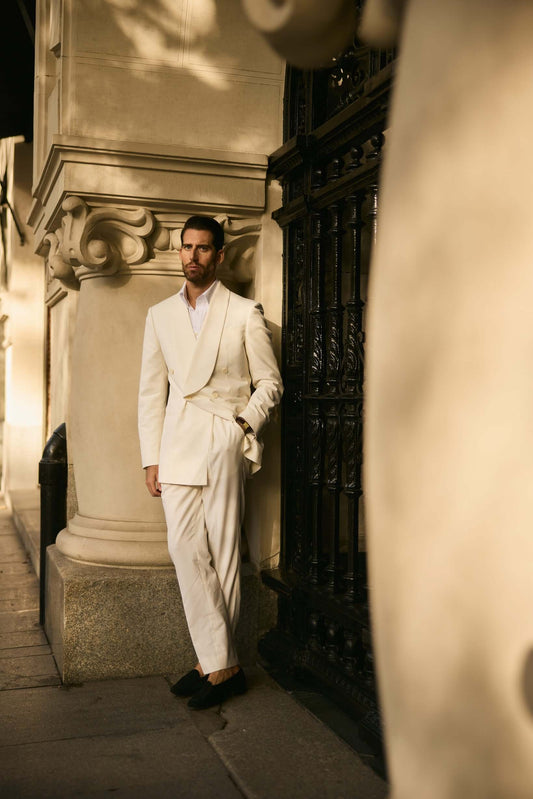
Two color conventions matter more at weddings than at almost any other event type. First, all-white or off-white outfits are a genuine faux pas that risks reading as an attempt to visually compete with or echo the bride's traditional attire, even when unintentional. This rule has loosened somewhat in contemporary weddings, but it remains one of the most consistently cited wedding-guest color mistakes, and it's worth avoiding entirely rather than testing how strictly a particular couple might enforce it.
Second, all-black attire at daytime or outdoor weddings specifically can read as somber or funeral-adjacent in a bright, daytime, outdoor setting. It is broadly acceptable at evening or indoor events, and when the invitation explicitly calls for black tie, all-black formalwear becomes an expected standard rather than an exception to avoid.
Daytime vs. Evening Weddings
Time of day is a meaningful signal for color and fabric choice independent of the stated formality level. Daytime weddings generally call for lighter colors and fabrics—tan, light grey, soft blue, and lighter-weight wools or linen blends all suit the brighter, often outdoor setting daytime weddings tend to involve.
Evening weddings shift the expectation toward darker suiting—navy and charcoal—largely independent of season or climate, since evening lighting and typically more formal indoor venues both favor a deeper, more traditional palette regardless of how warm the actual weather is outside.
Season Matters as Much as Time of Day
Season interacts with, rather than replaces, the daytime/evening distinction. A summer outdoor wedding, even one held during the day, still calls for genuinely lighter fabric weight than a winter wedding would—linen blends, lightweight wool, and breathable construction—even if the stated dress code, formal for instance, is otherwise identical to what a winter wedding at the same formality level might ask for.
Conversely, a winter wedding held indoors can comfortably carry heavier wool even at a relatively relaxed semi-formal level, since the setting and climate both support the heavier fabric.
What Not to Do as a Guest
The most significant guest-attire mistake, beyond color missteps, is wearing an actual tuxedo to an event that hasn't specifically called for black tie. Showing up in full formalwear when the groom and groomsmen are dressed in standard suits draws precisely the kind of attention a guest generally shouldn't want—it reads as either a misunderstanding of the dress code or, worse, a deliberate attempt to outdress the wedding party.
Statement accessories—a particularly bold tie, an attention-grabbing pocket square, or unconventional footwear—are worth toning down for the same underlying reason. A wedding guest's outfit should read as put-together and appropriate, not as a competing focal point against the wedding party's coordinated look.
Frequently Asked Questions
What should I wear if a wedding invitation doesn't specify a dress code at all?
A well-fitted suit in a neutral color such as navy or charcoal is a safe, broadly appropriate default when no dress code is stated, since it covers the middle ground between overdressed and underdressed for the widest range of wedding styles and venues.
Is it acceptable to wear the same suit to multiple weddings?
Yes. Reusing a well-fitted, versatile suit across multiple weddings is standard practice and goes unnoticed by nearly everyone. Varying the tie, pocket square, or shirt between events is generally enough to keep the overall look feeling fresh without requiring an entirely new suit for each occasion.
Can I wear a patterned suit as a wedding guest?
Generally, yes, particularly for daytime, outdoor, or more casual weddings, where a subtle pattern such as a light check or subtle stripe can read as appropriately festive without overshadowing the wedding party. For more formal or evening weddings, a solid, more conservative suit color is typically the safer choice.
The Bottom Line
Wedding guest dressing is fundamentally about reading the room and the invitation correctly, not about standing out. Match the stated dress code as a floor, respect the color conventions around white and black, and let the wedding party remain the visual focal point of the day.
Building a wedding-ready wardrobe for the season ahead? Explore our custom suits collection.