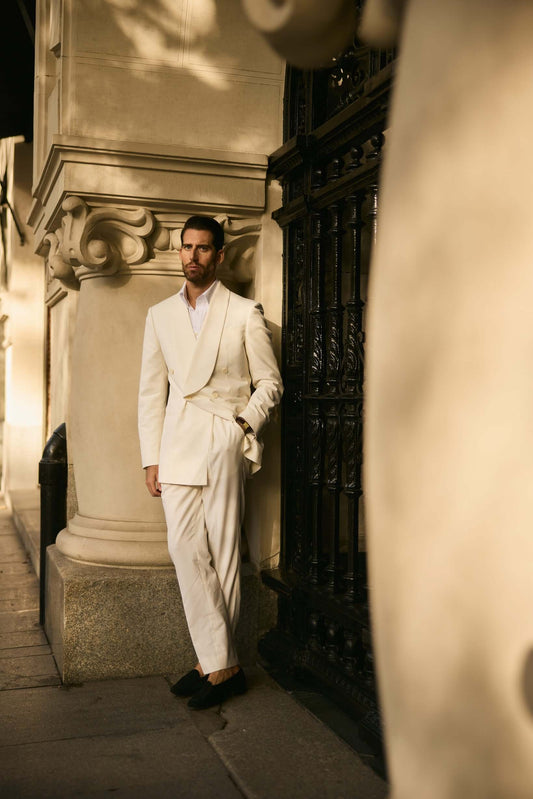

Bespoke vs Tailored Suit: Key Differences and Which to Choose
Last modified:Quick answer: A bespoke suit is made from an individual pattern drafted specifically for one client and usually involves several fittings. The term tailored suit is broader and may describe a ready-made suit altered by a tailor or a made-to-measure suit produced from an existing pattern adjusted to the wearer’s measurements. Bespoke offers greater control and traditional craftsmanship, while a made-to-measure tailored suit generally provides faster delivery and better value for most buyers.
Choosing between a bespoke suit and a tailored suit is not simply a question of which option is more expensive. The right choice depends on how the garment is patterned, how many fittings are involved, the level of customization offered, your timeline, and how much control you want over the finished suit.
The terminology can also be confusing. “Tailored” is often used as a broad marketing term, while bespoke and made-to-measure describe more specific production methods. This guide explains those differences clearly so you can select the right suit for your body, lifestyle, occasion, and budget.
Bespoke Suit vs Tailored Suit at a Glance
| Feature | Made-to-Measure Tailored Suit | Bespoke Suit |
|---|---|---|
| Pattern | An existing pattern is adjusted to the client’s measurements | An individual pattern is drafted specifically for the client |
| Fit | Highly personalized and suitable for most body types | Allows more detailed correction for posture, balance, and asymmetry |
| Customization | Extensive, within the options offered by the maker | Potentially broader, depending on the tailor |
| Fittings | Usually zero to two, depending on the process | Usually several fittings during construction |
| Turnaround | Often approximately four to eight weeks | Often approximately eight to twelve weeks or longer |
| Best For | Professionals, grooms, frequent travelers, and most custom-suit buyers | Tailoring enthusiasts and clients requiring extensive pattern correction |
| Typical Investment | Premium | Higher due to additional labor, fittings, and handwork |
Timelines, fitting requirements, and customization levels vary by tailor. Ask the maker how the pattern is produced and how many fittings are included rather than relying on the product label alone.
What Is a Tailored Suit?
A tailored suit is any suit that has been shaped or adjusted for an individual wearer. However, the phrase does not describe one universally standardized production method.
In some cases, a tailored suit is an off-the-rack garment altered at the sleeves, waist, jacket length, or trousers. In custom menswear, the phrase often refers to a made-to-measure suit created by modifying an existing pattern according to the customer’s measurements and selected design options.
If you're new to custom tailoring, it also helps to understand how a tailored suit compares with ready-made garments. Our guide on Tailored Suit vs Off-the-Rack explains why custom fitting can dramatically improve comfort, appearance, and long-term value.
Key Features of a Made-to-Measure Tailored Suit
- An established pattern is adjusted to the wearer’s measurements
- Fabric, lapel, pocket, lining, button, and trouser options may be personalized
- The process generally requires fewer fittings than bespoke tailoring
- Turnaround is typically shorter than a traditional bespoke commission
- It offers a strong balance of fit, customization, convenience, and value
At Bold Italia Suit, customers can personalize their garment through the Custom 2-Piece Suit Builder or create a more formal ensemble using the Custom 3-Piece Suit Designer.
What Is a Bespoke Suit?
A bespoke suit is commissioned for an individual client using a pattern drafted specifically for that person. Rather than modifying a standard block, the tailor develops the pattern around the client’s measurements, posture, proportions, balance, and stylistic preferences.
The garment is normally refined through several fittings as its structure develops. This allows the tailor to assess details such as shoulder slope, sleeve pitch, collar position, jacket balance, trouser line, and body asymmetry before completing the suit.
Key Features of a Bespoke Suit
- An individual pattern drafted for one client
- Several fittings during the construction process
- Extensive control over proportion, structure, and styling
- Greater opportunity for handwork and traditional tailoring techniques
- A longer production timeline and higher labor cost
Bespoke is best understood as a method of creating a garment rather than simply a synonym for an expensive or highly customized suit.
Want to explore the history and craftsmanship behind bespoke tailoring in greater detail? Read our complete guide: What Is a Bespoke Suit?
Bespoke Suit vs Tailored Suit: The Core Differences

1. Pattern Creation
A made-to-measure tailored suit begins with an established pattern or block. The maker adjusts selected dimensions according to the customer’s measurements and fitting requirements.
A bespoke tailor drafts an individual pattern specifically for the client. The pattern can account for details beyond basic measurements, including shoulder angle, posture, body asymmetry, front and back balance, and the relationship between the jacket and trousers.
2. Fit and Body Correction
Both methods can produce an excellent fit. A high-quality made-to-measure process is suitable for most men and can refine the chest, waist, sleeves, jacket length, trouser rise, and overall silhouette.
Bespoke offers greater freedom to correct complex posture or proportion issues because the pattern is created and refined during several fittings. This can be particularly useful for pronounced shoulder imbalance, forward posture, an uneven hip line, or other substantial asymmetries.
3. Number of Fittings
A made-to-measure order may require no preliminary fitting beyond the initial measurement process, although some makers include an adjustment or final fitting after the garment arrives.
Bespoke tailoring usually involves several stages. Depending on the tailor, these may include an initial fitting, an intermediate fitting, and one or more refinements before completion.
4. Construction and Handwork
Construction quality should be assessed separately from the production label. A made-to-measure suit may use fused, half-canvas, or full-canvas construction, while a bespoke suit may include extensive hand padding, hand-set sleeves, and other traditional techniques.
Bespoke generally involves more manual labor, but a suit should not be judged by handwork alone. Fabric quality, canvas construction, cutting, pressing, finishing, and the skill of the maker all affect the final result.
5. Customization
Made-to-measure suits can offer extensive choices, including fabric, lapel shape, pockets, vents, buttons, linings, monograms, trouser details, and fit preferences. The available combinations are normally selected from a structured menu.
Bespoke tailoring may allow the client and tailor to develop details beyond a predefined menu, including original proportions, unusual styling, specialized internal construction, or highly specific design requests.
6. Turnaround Time
Made-to-measure is generally faster because the pattern-development and fitting stages are more streamlined. Bespoke takes longer because the garment is progressively fitted, assessed, and refined.
Actual delivery times depend on the tailor, production location, fabric availability, order complexity, seasonal demand, and the number of adjustments required.
7. Price
Bespoke normally costs more because it requires individual pattern drafting, additional fittings, specialist labor, and more time from the cutter and tailor. Made-to-measure distributes pattern development and production across a more standardized process, making custom clothing accessible at a lower investment.
Browse Bold Italia’s custom suit and tuxedo collection to compare fabrics, styling options, and garment configurations.
Who Actually Needs a Bespoke Suit?
Bespoke tailoring is not automatically the best choice for every buyer. Most professionals, grooms, executives, and first-time custom-suit customers can achieve an excellent result through a carefully executed made-to-measure process.
Bespoke may be especially valuable when a client has significant asymmetry, complex posture considerations, unusual proportions, or design requirements that cannot be accommodated through an existing pattern system. It also appeals to customers who value traditional tailoring, repeated interaction with a cutter, and detailed control over the garment’s construction.
For buyers with relatively balanced proportions who prioritize convenience, customization, and value, made-to-measure will usually be the more practical choice.
Off-the-Rack vs Tailored vs Made-to-Measure vs Bespoke
The word “tailored” can overlap with several suit categories. The clearest way to compare them is by looking at how each garment is produced.
| Suit Type | How It Is Made | Fit Process | Customization | Best For |
|---|---|---|---|---|
| Off-the-Rack | Produced in standard sizes | Purchased ready-made and altered where possible | Limited | Immediate availability and lower budgets |
| Altered or Tailored Ready-Made Suit | A standard-size garment is adjusted by a tailor | Sleeves, waist, trouser length, and other alterable areas are refined | Low | Improving the fit of an existing suit |
| Made-to-Measure | An existing pattern is modified using the client’s measurements | Measurements are collected in person or remotely, followed by adjustments when required | High | Most buyers seeking a custom fit and personalized design |
| Bespoke | An individual pattern is drafted specifically for the client | Several fittings refine the garment during construction | Very extensive | Maximum pattern control, craftsmanship, and personalization |
Retailers do not always use these terms consistently. Before ordering, ask whether the suit is altered from a finished garment, made from a modified block, or cut from an individual pattern.
Which Should You Choose: Bespoke or Tailored?
| Your Priority | Recommended Option | Why |
|---|---|---|
| Your first custom suit | Made-to-Measure Tailored Suit | It provides extensive personalization without the time and cost of bespoke |
| A wedding suit | Made-to-Measure or Bespoke | Choose according to your budget, schedule, and desired level of craftsmanship |
| A professional wardrobe | Made-to-Measure Tailored Suit | It is practical for ordering several coordinated business suits |
| Complex posture or pronounced asymmetry | Bespoke | An individual pattern allows more extensive body and balance correction |
| Maximum creative control | Bespoke | The tailor can develop proportions and construction beyond a standard option menu |
| Remote ordering or frequent travel | Made-to-Measure Tailored Suit | A streamlined measurement and ordering process reduces repeated visits |
| Traditional craftsmanship as the priority | Bespoke | The process emphasizes individual pattern cutting, fittings, and handwork |
| Best overall balance of fit and value | Made-to-Measure Tailored Suit | It meets the needs of most custom-suit buyers at a more accessible investment |
Choose a Made-to-Measure Tailored Suit If:
- You want a personalized suit without several in-person fittings
- You need the garment within a more predictable timeline
- You want extensive styling choices at a comparatively accessible price
- You are building a business, wedding, or occasionwear wardrobe
- You prefer an online or technology-supported measurement process
Choose a Bespoke Suit If:
- You want an individual pattern created specifically for your body
- You have substantial posture, balance, or asymmetry considerations
- You value repeated fittings and direct collaboration with a cutter
- You want maximum control over proportion, structure, and construction
- You are comfortable with a longer timeline and higher investment
Buyers considering a suit for a ceremony can also review Bold Italia’s custom wedding suits, while professionals can explore custom business suits.
Can a Tailored Suit Fit Like a Bespoke Suit?
For most men, yes. A well-executed made-to-measure tailored suit can deliver an outstanding fit that satisfies business professionals, wedding clients, and everyday luxury buyers. Modern pattern engineering, careful measurements, quality construction, and thoughtful alterations allow made-to-measure garments to fit exceptionally well.
Bespoke remains the superior option when extensive posture correction, significant body asymmetry, or complete design freedom is required. However, for the majority of customers, a premium made-to-measure suit offers an excellent balance of fit, craftsmanship, convenience, and value.
Modern smartphone-based measurement technology can also simplify remote ordering while supporting accurate body measurements. Learn more about AI-assisted suit measurements.
Choosing the correct silhouette also influences how a custom suit fits. Compare Slim Fit vs Regular Fit Suits to understand which style complements your build.
Why Many Buyers Choose Made-to-Measure Over Bespoke
Made-to-measure has become a practical option for buyers who want a personalized suit without the time commitment of a traditional bespoke commission. The process combines individual measurements with an established pattern system, allowing the maker to offer customization while maintaining a more streamlined production workflow.
It is particularly suitable for professionals, wedding parties, repeat customers, and clients ordering remotely. Buyers can personalize the appearance of the garment while avoiding several in-person appointments.
Technology-supported measurement processes can further simplify remote ordering. However, measurement technology is only one part of the result; pattern engineering, garment construction, quality control, and final alterations remain equally important.
Read more about the role of measurement technology in custom suiting.
How Much Can You Customize?
Both made-to-measure and bespoke suits can provide extensive personalization, but the boundaries differ.
Common Made-to-Measure Options
- Notch, peak, or shawl lapels
- Single-breasted or double-breasted fronts
- Jetted, flap, or patch pockets
- Single, double, or ventless jacket backs
- Button materials and configurations
- Lining colors and patterns
- Monograms and personalized embroidery
- Trouser pleats, side adjusters, belt loops, cuffs, and fit preferences
Bespoke may allow the tailor to develop proportions and structural details outside a predefined menu, including lapel width, button placement, pocket positioning, shoulder expression, internal support, and other elements designed around the client’s preferences.
Explore these possibilities through Bold Italia’s 2-piece suit configurator, 3-piece suit configurator, or custom sport coat designer.
Not sure which style is right for you? Browse our guide to different types of men's suits to compare business suits, tuxedos, wedding suits, double-breasted styles, and more.
Construction, Durability, and Longevity
A suit’s durability is not determined solely by whether it is made-to-measure or bespoke. Fabric quality, canvas construction, stitching, pressing, frequency of wear, garment rotation, storage, and maintenance all influence how the suit performs over time.
Fused Construction
Fused jackets use an adhesive interlining to create structure. They are generally more affordable but may not develop the same natural drape or longevity associated with higher-level canvas construction.
Half-Canvas Construction
A half-canvas jacket uses a sewn canvas through the chest and lapel, with fused support lower in the jacket. It offers a strong balance of structure, comfort, durability, and value.
Full-Canvas Construction
A full-canvas jacket uses a floating internal canvas through most of the front. Over time, the canvas can conform more naturally to the wearer and create a refined drape.
Both made-to-measure and bespoke suits may be available in different construction levels. Ask the maker about the internal structure rather than assuming that the production label guarantees a particular canvas method.
Proper care is equally important. Review the complete suit cleaning and maintenance guide for advice on brushing, steaming, storage, rotation, and dry cleaning.
How Professional Tailors Evaluate Suit Fit

Professional tailoring goes far beyond chest and waist measurements. A skilled tailor evaluates how every part of the garment works together to create balance, comfort, and a flattering silhouette.
- Shoulders: Should follow your natural shoulder line without extending beyond it.
- Collar: Should rest smoothly against the shirt collar without gaps.
- Sleeves: Sleeve pitch should follow your natural arm position without twisting.
- Chest: Should close comfortably without pulling or excess fabric.
- Waist: Should create shape while allowing comfortable movement.
- Trouser Rise: Should sit naturally without pulling across the seat.
- Trouser Break: Should complement both shoe style and personal preference.
- Overall Balance: The front and back of the jacket should hang evenly according to posture.
These details collectively determine whether a suit merely fits or truly flatters the wearer.
Which Option Offers Better Long-Term Value?
The better value is not always the garment with the lowest initial price. Consider how often the suit will be worn, whether it can serve several occasions, how well it fits, whether it can be altered later, and how long its fabric and construction are likely to last.
For most buyers, a high-quality made-to-measure suit provides the strongest balance of fit, personalization, convenience, and cost. It may be worn for business meetings, weddings, formal dinners, interviews, and other important events, reducing its cost per wear over time.
Bespoke may provide better personal value for someone who prioritizes traditional craftsmanship, requires extensive pattern correction, or wants to participate closely in the creation of the garment. Its value lies less in convenience and more in the experience, individual pattern, and depth of execution.
Fabric also affects comfort, versatility, and longevity. Compare common choices in the linen vs wool suit guide or review Bold Italia’s fabric collection.
Common Misconceptions About Bespoke and Tailored Suits

-
Myth: Bespoke is always necessary for an excellent fit.
Reality: A well-executed made-to-measure suit can provide an exceptional fit for most body types. -
Myth: Every expensive suit is bespoke.
Reality: Price does not determine the production method. Premium fabric, branding, construction, and finishing can also increase the cost. -
Myth: “Tailored,” “custom,” and “made-to-measure” always mean the same thing.
Reality: Brands use these terms differently. Ask how the pattern is created and whether the garment is altered, made-to-measure, or bespoke. -
Myth: Bespoke guarantees superior fabric and construction.
Reality: Bespoke describes the pattern and fitting process. Fabric and construction quality must still be evaluated separately. -
Myth: More fittings automatically produce a better suit.
Reality: Fittings create opportunities for refinement, but the result still depends on the skill of the cutter, tailor, and production team.
Frequently Asked Questions
Is a bespoke suit better than a tailored suit?
Bespoke is not universally better. It offers an individual pattern, several fittings, and greater control over body correction and construction. A made-to-measure tailored suit is generally more convenient and provides excellent fit and customization for most buyers.
What is the main difference between bespoke and made-to-measure?
Made-to-measure modifies an existing pattern according to the customer’s measurements. Bespoke begins with an individual pattern drafted specifically for the client and is refined through several fittings.
Is a tailored suit the same as a made-to-measure suit?
Not always. “Tailored” is a broad term that may describe an altered ready-made suit or a custom garment. Made-to-measure refers more specifically to a suit produced by adjusting an established pattern to the customer’s measurements.
How many fittings does a bespoke suit require?
The number varies by tailor and garment complexity, but bespoke commissions normally involve several fittings before completion.
Can a made-to-measure suit accommodate body asymmetry?
Many made-to-measure systems can account for moderate shoulder, posture, sleeve, and leg differences. More complex asymmetry may benefit from the flexibility of an individually drafted bespoke pattern.
How long does a custom suit take to make?
Delivery times vary by maker. Made-to-measure suits often take several weeks, while bespoke commissions frequently require a longer period because of the additional pattern work and fittings.
Are bespoke suits always handmade?
Bespoke suits commonly include substantial handwork, but the amount varies among tailors. Some stages may still involve machines. Ask which elements are cut, sewn, padded, and finished by hand.
Can a custom suit be ordered online?
Yes. Many made-to-measure suits can be ordered online using guided measurements or smartphone-based measurement technology. Traditional bespoke normally requires direct fittings with the tailor, although service models vary.
Which is better for a wedding: bespoke or made-to-measure?
Both can work well. Made-to-measure is usually the practical choice for most grooms and wedding parties, while bespoke may suit a groom who wants an individual pattern, extensive craftsmanship, and a more involved commissioning experience.
How long should a quality suit last?
Longevity depends on the fabric, construction, frequency of wear, rotation, storage, maintenance, and whether the garment can accommodate future alterations. Production method alone does not determine lifespan.
Conclusion: Is Bespoke or Tailored Right for You?
The choice between a bespoke suit and a tailored suit depends on the process and experience you value. Bespoke is suited to buyers who want an individual pattern, repeated fittings, extensive body correction, and close involvement in the garment’s creation.
For most modern buyers, a made-to-measure tailored suit provides the more practical balance. It offers a personalized fit, premium fabric choices, broad customization, and a streamlined ordering process without the extended timeline of a traditional bespoke commission.
Before choosing, ask the maker how the pattern is created, what construction is used, how many fittings or alterations are included, and which design options are available. Those answers reveal far more than the label alone.
Explore Bold Italia’s custom suits and suit and tuxedo collection, or contact the Bold Italia team for guidance on selecting the right fabric, fit, and configuration.
Still comparing your options? Continue exploring our guides on why custom tailored suits fit better, custom suits vs ready-made suits, and the ultimate guide to tailored suits before making your decision.