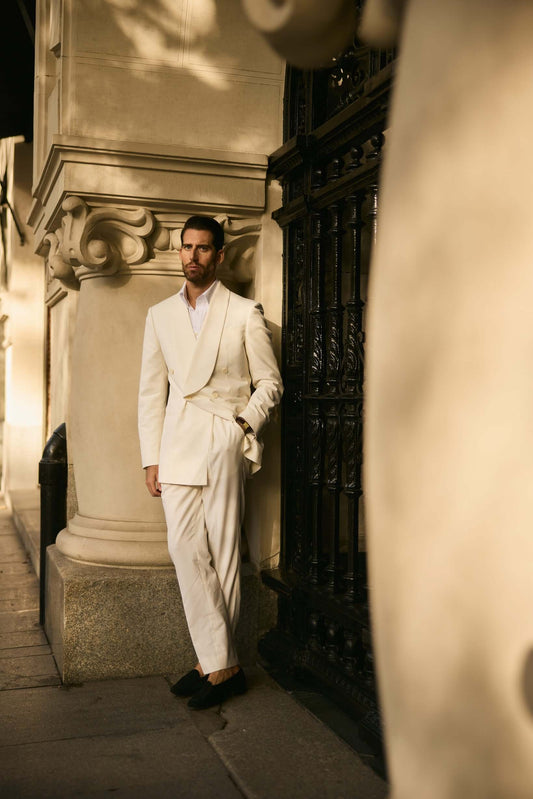

Custom Tailored Suits: Why They Fit Better Than Off-the-Rack
Last modified:Share
A suit can be the right size and still fit poorly. The shoulders may extend too far, the jacket may pull across the chest, the sleeves may hang unevenly, or the trousers may fit the waist while feeling restrictive through the seat. That happens because standard suit sizes are built around predetermined proportions — while real bodies rarely follow those proportions exactly.
Custom tailored suits fit better because the garment is made around the wearer's individual measurements, proportions and posture rather than relying solely on a standard off-the-rack size. Adjustments can account for differences in shoulder slope, chest shape, arm position, torso length, waist, seat and trouser proportions, creating a more balanced fit throughout the entire suit.
That does not mean every custom suit automatically fits perfectly or that every off-the-rack suit fits poorly. A well-cut ready-made suit can work extremely well when its base proportions already match your body. The advantage of custom tailoring is the ability to address fit variables that standard sizing cannot easily accommodate.
Why Do Custom Tailored Suits Fit Better?
The biggest difference is not simply the number of measurements taken. It is how those measurements work together to determine the balance and proportions of the finished garment.
A properly fitted custom suit can account for details such as:
- Shoulder width and shoulder slope
- Chest and waist proportions
- Natural posture and jacket balance
- Arm length and arm position
- Torso length
- Seat and hip proportions
- Thigh and leg shape
- Trouser rise and length
- Preferred ease and silhouette
These measurements and proportional adjustments work together. Changing one area can affect how another part of the garment hangs, which is why good suit fit should be evaluated as a complete system rather than as a list of independent measurements.
If you're considering having a suit made around your measurements, see Bold Italia's custom suits or start building a custom two-piece suit.
Custom Suit vs. Off-the-Rack Fit: What's the Difference?
Off-the-rack suits are produced in standardized sizes so they can accommodate a broad range of customers. Alterations can significantly improve the fit, but the tailor still begins with an existing garment and its predetermined proportions.
Custom tailoring begins much closer to the individual wearer's measurements and desired proportions. That gives the garment maker more control over areas that can be difficult — or sometimes impractical — to correct through ordinary alterations.
| Fit Factor | Custom Tailored Suit | Off-the-Rack Suit |
|---|---|---|
| Starting point | Individual measurements and fit preferences | Standardized size and predetermined proportions |
| Shoulders | Can be specified around the wearer's proportions | Must begin with the existing jacket structure |
| Posture | Can be considered during the fitting process | Limited by the original pattern and construction |
| Jacket length | Selected for the wearer's proportions and preference | Primarily determined by the purchased size |
| Trouser proportions | Waist, rise, seat and leg can be specified together | Begin with standardized trouser proportions |
| Style choices | Extensive customization | Limited to available designs |
| Alterations | Final adjustments may still be required | Often needed to refine the standard fit |
For a deeper buying comparison, read our guide to custom suits vs. ready-made suits.
1. Custom Tailoring Accounts for More Than Chest and Waist Size
Conventional suit sizing often starts with a chest measurement and a length category such as short, regular or long. Those measurements are useful, but they cannot describe every proportion of the person wearing the garment.
Two men with the same chest size can have different shoulder widths, arm lengths, waist measurements, torso lengths and postures. They may therefore need very different jackets even though both technically wear the same retail size.
Custom tailoring allows those differences to be considered together rather than requiring the wearer to conform to one predetermined size profile.
2. Shoulder Fit Can Be Addressed From the Beginning
The shoulders are one of the most important areas of a suit jacket because they influence how the upper portion of the garment hangs.
A jacket that is too wide through the shoulders can extend beyond the natural shoulder line. One that is too narrow may create tension through the upper back and sleeves. Differences in shoulder slope can also influence the way the collar and chest sit.
With custom tailoring, shoulder width and slope can be considered before the garment is made rather than trying to correct an incompatible shoulder structure afterward.
3. Posture Changes How a Suit Hangs
Suit fit is three-dimensional. Two people with similar circumference measurements can still require different garments because they stand differently.
Natural posture, shoulder position and the relationship between the front and back of the torso can influence jacket balance. When these variables are not considered, you may see symptoms such as a collar that pulls away from the shirt, diagonal wrinkles, an uneven hem or fabric that does not settle naturally.
A custom fitting process can account for these proportional differences instead of treating chest, waist and sleeve measurements as the complete picture.
4. Jacket Length and Waist Suppression Can Match Your Proportions
Jacket length affects the visual balance between your torso and legs. The position of the jacket waist also affects the overall silhouette.
With a standard suit, both are largely determined by the manufacturer's pattern. Alterations may refine the shape, but there are practical limits to how much the original proportions can be changed.
Custom tailoring allows these decisions to be made with the wearer's height, torso length and preferred silhouette in mind from the beginning.
If you're deciding between different silhouettes, our guide to men's suit styles and fits explains classic, modern and slimmer approaches in more detail.
5. Sleeves Can Follow Your Natural Arm Position
Sleeve fit involves more than sleeve length. The way your arms naturally hang can affect how smoothly a jacket sleeve falls.
A sleeve that does not align well with the wearer's natural arm position can develop twisting or diagonal wrinkles. Custom tailoring provides an opportunity to consider arm position alongside sleeve length, shoulder fit and the overall jacket balance.
6. Custom Trousers Can Fit the Waist, Seat and Legs Together
Ready-made trousers can fit correctly at the waist while being too tight through the seat or thighs. Going up a size may solve one problem while creating excess fabric somewhere else.
Custom trousers can consider the relationship between the waist, rise, seat, thigh, knee and leg opening. This is particularly useful for men whose upper and lower body proportions do not closely match a standard retail pattern.
You can also customize your dress pants or review Bold Italia's custom slacks options.
7. Better Fit Can Improve Comfort and Movement
A suit should look fitted without feeling restrictive. Those two goals are not opposites.
When the chest, back, armholes, seat and thighs have appropriate room, the garment can maintain a clean silhouette while allowing normal movement. A suit that is simply made tighter may look fitted while standing still but become uncomfortable when sitting, walking or reaching.
The objective of custom tailoring is therefore not to remove as much fabric as possible. It is to distribute the right amount of room in the right places.
8. Customization Goes Beyond Fit
Fit may be the main reason to choose a custom suit, but personalization is another major advantage. Depending on the garment and tailoring program, you may be able to select details such as:
- Notch or peak lapels
- Single- or double-breasted styling
- Jacket vents
- Pocket styles
- Buttons
- Lining
- Trouser rise
- Pleated or flat-front trousers
- Side adjusters or belt loops
- Fabric, color and pattern
These choices allow you to build a garment for its intended purpose rather than selecting the closest available combination from a rack.
For example, a custom business suit can prioritize versatility and professional proportions, while wedding suits can incorporate details selected specifically for the ceremony, venue and wedding style.
9. Fabric and Construction Should Be Evaluated Separately From "Custom"
One common misconception is that every custom suit automatically uses superior fabric or construction. That is not necessarily true.
Custom describes how the garment is specified and fitted; it does not by itself guarantee a particular construction method or fabric quality.
Depending on the maker and garment, suits may use fused, half-canvas or full-canvas construction. Fabrics also vary significantly in fiber, weave, weight and performance.
When comparing suits, evaluate fit, fabric and construction independently rather than assuming price or the word "custom" guarantees all three.
Climate matters as well. For warmer conditions, compare options such as linen suits and other lightweight fabrics discussed in our summer suit fabric guide.
10. Modern Measurement Technology Can Make Remote Custom Fitting Easier
Custom tailoring traditionally depends on measurements taken in person. Modern digital measurement systems can provide another way to collect body measurements when customers are ordering remotely.
Bold Italia Suit uses AI-enabled measurement technology that allows measurements to be captured using a smartphone, helping connect online customization with a measurement-driven fitting process.
Measurement technology is only one part of the process. Accurate garment specifications, pattern adjustments, construction and quality control still matter to the final fit.
For more detail, read how AI suit measurements compare with traditional measurement methods.
Custom, Made-to-Measure and Bespoke Are Not Exactly the Same
These terms are often used interchangeably in everyday shopping, but they can describe different approaches to making a suit.
- Off-the-rack: A finished garment produced in standardized sizes and altered after purchase if necessary.
- Made-to-measure: Typically begins with an existing base pattern that is adjusted using the customer's measurements and selected options.
- Bespoke: Traditionally involves creating an individual pattern for the customer and a more extensive fitting and tailoring process.
- Custom: A broader term whose exact meaning can vary between brands, so customers should check how the company's measurement, pattern and fitting process actually works.
If you're comparing these options, read our bespoke vs. tailored suit guide.
When Is a Custom Tailored Suit Most Worth It?
A custom suit can be particularly useful when:
- Standard jackets consistently fit your chest but not your shoulders or waist.
- Your upper- and lower-body proportions do not match typical suit sizing.
- You frequently need extensive alterations on ready-made suits.
- You want specific jacket, trouser, fabric or styling details.
- You are buying a suit for an important event and want greater control over the finished look.
- You want a repeatable fit for a professional wardrobe.
For frequent professional wear, see our business professional attire guide. If you're preparing for a wedding, start with our guide to wedding suits for men.
When Can an Off-the-Rack Suit Be the Better Choice?
Custom is not automatically the right choice for every buyer. If an off-the-rack jacket already fits cleanly through the shoulders, chest and overall length, relatively minor alterations may produce an excellent result.
An off-the-rack suit can make sense when:
- Your proportions closely match the brand's standard pattern.
- You need a suit quickly.
- You have a limited budget.
- The garment requires only straightforward alterations.
- You prefer trying on the finished garment before purchasing it.
The better question is therefore not simply, "Is custom better?" It is: Which option gives you the best combination of fit, quality, budget and intended use?
How Should a Well-Fitted Custom Suit Look?
When evaluating the finished suit, check the complete silhouette rather than focusing on the size label.
- Shoulders: The jacket should follow the natural shoulder line without obvious overhang or severe tension.
- Collar: The jacket collar should sit cleanly near the shirt collar rather than creating a large visible gap.
- Chest: The front should lie cleanly without pronounced pulling around the button.
- Sleeves: They should fall cleanly and finish at an intentional length relative to the shirt cuff.
- Jacket length: It should look balanced with your torso and legs.
- Trousers: The waist, seat and thighs should feel comfortable without excessive fabric or obvious strain.
- Hem: Trouser length should complement the intended break and shoe style.
- Movement: You should be able to sit, walk and move naturally without excessive restriction.
Fit preferences can still vary. A slim silhouette and a more classic silhouette may both fit correctly even though they use different amounts of ease. Our guide to slim fit vs. regular fit suits explains that distinction.
Final Verdict: Why Custom Tailored Suits Fit Better
Custom tailored suits have a fundamental fit advantage: they can be specified around the individual rather than requiring the individual to match a predetermined retail size.
Measurements are only the beginning. Shoulder slope, posture, jacket balance, sleeve position, trouser rise, proportions and preferred ease can all influence how a suit looks and feels. When those elements are considered together, the result can be a cleaner silhouette, greater comfort and a garment that feels proportioned specifically for the person wearing it.
That does not make every custom suit superior to every off-the-rack suit. Fabric, construction, patternmaking, measurement accuracy and execution still matter. But for men who struggle with standardized sizing — or simply want greater control over fit and design — custom tailoring offers possibilities that alterations alone cannot always provide.
Ready to create yours? Explore custom suits for men, design a custom two-piece suit, or build a custom three-piece suit.