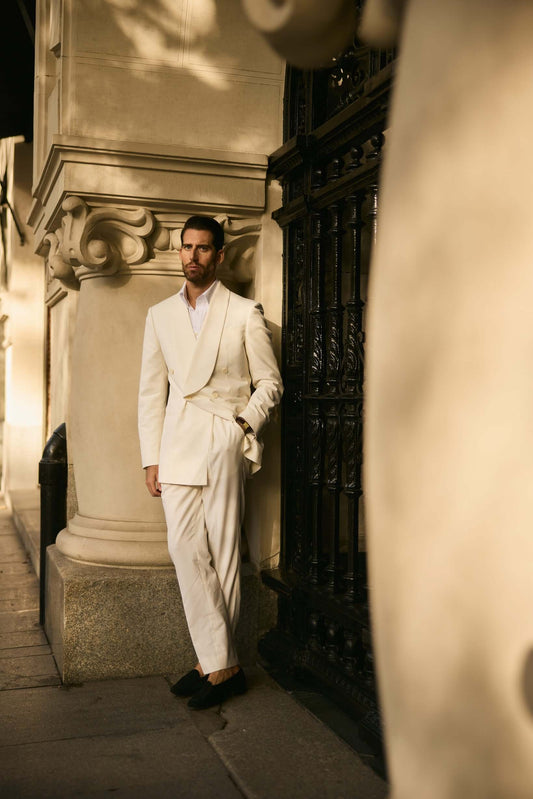

Italian Tailoring, Explained: What Makes an Italian Suit Different
Last modified:"Italian suit" has become shorthand for anything sharp, well-fitted and effortlessly stylish. But Italian tailoring is more than a marketing label. It represents a family of tailoring traditions with distinctive approaches to jacket construction, shoulder shape, proportion, fabric and movement.
Quick answer: Italian suits are traditionally known for softer construction, lighter shoulder padding, higher armholes, a closer-fitting silhouette and lightweight fabrics. Compared with many classic British suits, which emphasize structure and a more defined shoulder line, Italian tailoring generally follows the body's natural shape more closely. However, there is no single Italian cut: Neapolitan, Milanese, Roman and Florentine tailoring each interpret the tradition differently.
Key Takeaways
- Italian tailoring generally favors softer construction and less internal structure than traditional British tailoring.
- Many Italian jackets use natural or lightly padded shoulders, higher armholes and a defined waist to create a clean silhouette without excessive bulk.
- Italian suits are not simply slim-fit suits. Italian tailoring describes a construction and design tradition; slim fit only describes how closely a garment sits against the body.
- There is no single Italian tailoring style. Neapolitan, Milanese, Roman and Florentine tailoring each have their own proportions and construction techniques.
- Lightweight wool, linen and breathable blends are closely associated with Italian tailoring because they complement softer construction and warmer climates.
- Fit matters more than the label. An Italian-inspired suit should follow the body cleanly without becoming restrictive through the chest, shoulders, seat or thighs.
What Makes an Italian Suit Different?

There is no single blueprint for an Italian suit, but several characteristics appear repeatedly across Italian tailoring traditions. Compared with more structured approaches to tailoring, an Italian suit often emphasizes a natural silhouette, freedom of movement and clean proportions rather than building a rigid shape around the wearer.
- Softer shoulders: Italian jackets often use less shoulder padding, while some Neapolitan jackets use very little or none.
- Lighter construction: Reduced internal structure helps the jacket feel softer and allows it to follow the wearer's natural shape.
- Higher armholes: A properly cut higher armhole can create a cleaner line and allow the arms to move without pulling the entire jacket upward.
- Defined waist: Many Italian silhouettes create more shape through the torso than traditional American suit cuts.
- Controlled jacket length: Modern Italian jackets are often slightly shorter, although the correct length still depends on the wearer's proportions and the tailoring tradition.
- Distinctive button stance: Many Italian jackets use a relatively high fastening point to reinforce a compact, elegant silhouette.
- Cleaner trouser line: Italian trousers are frequently cut with less excess fabric and a more controlled taper through the leg.
- Lightweight fabrics: Fine wool, linen and breathable blends complement the softer construction associated with Italian tailoring.
The important distinction is that Italian tailoring should not simply mean a tight suit. A properly fitted Italian suit can sit close to the body while still providing comfortable movement through the chest, shoulders, seat and legs.
How Italian Suit Construction Is Different
One of the most important differences between Italian tailoring and more structured tailoring traditions is what happens inside the jacket. The silhouette you see from the outside is influenced by canvas, shoulder padding, sleeve construction, armhole height and how aggressively the jacket is shaped around the body.
Traditional British tailoring often uses greater internal structure to create a stronger chest and shoulder line. Italian tailoring generally moves in the opposite direction, particularly in southern traditions such as Neapolitan tailoring, where lightness and natural movement are central to the design.
Softer, More Natural Shoulders
Many Italian jackets use less shoulder padding than heavily structured suit styles. Instead of creating a pronounced architectural shoulder, the jacket is designed to follow the wearer's natural shoulder line more closely.
This can make the suit appear less rigid while also helping it feel easier to wear for long periods.
Lighter Internal Construction
Italian tailoring is frequently associated with softer canvassing and reduced internal bulk. This does not mean lower-quality construction. A finely made lightweight jacket can involve considerable tailoring skill precisely because it has less internal structure available to disguise problems with balance, proportion or fit.
The result is often a jacket that feels lighter on the body and moves more naturally through the shoulders and torso.
Higher Armholes
Higher armholes are another characteristic commonly associated with well-cut Italian jackets. When correctly proportioned, a higher armhole allows the arm to move more independently from the jacket body.
This is important because an excessively low armhole can cause the jacket to lift or distort whenever the wearer raises an arm.
What Is a Spalla Camicia Shoulder?
Neapolitan tailoring is especially known for the spalla camicia, or "shirt shoulder." Instead of building a heavily padded sleeve head, the sleeve is inserted in a way that resembles the construction of a shirt.
The result is a soft transition from shoulder to sleeve. Some examples also show subtle rippling near the sleeve head, a detail closely associated with traditional Neapolitan tailoring.
The Italian Suit Silhouette

Construction is only part of what gives an Italian suit its appearance. Jacket length, waist suppression, lapel shape, button position and trouser proportions all contribute to the finished silhouette.
Jacket Length
Contemporary Italian jackets are often somewhat shorter than traditional British jackets. However, "Italian" should never be used as an excuse for a jacket that is simply too short.
The correct jacket length still needs to work with the wearer's torso, legs and overall proportions.
Chest and Waist
Italian tailoring often creates a cleaner, closer line through the torso, with visible waist definition rather than a straight, boxy shape.
That shaping should come from the pattern and construction rather than simply sizing down. A jacket that pulls across the fastening button or develops strong horizontal tension lines is too tight, regardless of the style.
Lapels
Italian lapels vary considerably by region and tailor, but balanced proportions are important. Wider lapels can create a more expressive, traditional appearance, while more moderate lapels give the jacket a quieter contemporary profile.
The lapel should also remain proportionate to the wearer's chest, shoulder width and jacket length.
Button Stance
The fastening point influences how long or compact the jacket appears. Many Italian jackets use a relatively high button stance, although the exact position depends on the cut and the wearer's proportions.
Trousers
Italian tailoring frequently favors a clean trouser line with controlled fabric through the seat and thigh and some taper toward the hem. That does not automatically mean skinny trousers.
Good Italian-style trousers should follow the leg without pulling across the hips or thighs or restricting normal movement.
For a broader comparison of tailoring silhouettes, see our guide to men's suit styles.
Italian vs. British vs. American Suits

Italian, British and American tailoring developed with different priorities, which is why suits from each tradition can create noticeably different silhouettes. These distinctions are traditions rather than absolute rules, but they provide a useful starting point for understanding the major suit styles.
| Feature | Italian Suit | British Suit | American Suit |
|---|---|---|---|
| Shoulder | Often softer and more natural | Traditionally more structured and defined | Traditionally natural to moderately structured |
| Jacket Fit | Often closer through the torso | Structured with defined shaping | Traditionally straighter and roomier |
| Jacket Length | Often slightly shorter in modern cuts | Traditionally longer | Moderate to traditional length |
| Internal Structure | Generally lighter | Generally more structured | Traditionally simpler and less shaped |
| Armholes | Often higher | Moderate to high | Traditionally lower and roomier |
| Trousers | Clean and often tapered | Classic and structured | Traditionally roomier |
| Overall Impression | Soft, elegant and body-conscious | Structured, authoritative and formal | Comfortable, practical and relaxed |
A traditional British suit generally creates shape through structure: a defined shoulder, controlled chest and balanced jacket length. Italian tailoring is more likely to let the natural body provide some of that shape, especially in softer regional styles. Traditional American tailoring historically favored ease of movement and a straighter silhouette.
Modern tailoring frequently borrows elements from all three traditions, so the label on a suit matters less than its actual construction and proportions.
Italian Tailoring Isn't One Style

One of the biggest misconceptions about Italian suits is that Italy has a single national tailoring style. In reality, Italian tailoring is a family of regional traditions. Naples, Milan, Rome and Florence developed different approaches to structure, proportion and formality.
Neapolitan Tailoring
Neapolitan tailoring represents the softest and most relaxed end of the Italian tailoring spectrum. Jackets are typically lightweight, minimally padded and designed to move easily with the wearer.
The natural shoulder and spalla camicia construction are strongly associated with Naples, along with a general preference for comfort and fluidity over rigid structure.
Milanese Tailoring
Milanese tailoring is generally cleaner and somewhat more structured than Neapolitan tailoring. The silhouette tends to feel restrained and polished while remaining recognizably lighter than many traditional British cuts.
This makes Milanese tailoring useful evidence that "Italian suit" does not automatically mean completely unstructured.
Roman Tailoring
Roman tailoring often occupies a middle ground between the softness of Naples and the sharper structure associated with northern Italian tailoring. The result can be elegant and clean without appearing excessively relaxed.
Florentine Tailoring
Florentine tailoring has its own approach to jacket balance, shoulder treatment and proportion. Like the other regional traditions, it reinforces an important point: Italian tailoring should be understood as a group of related approaches rather than one standardized suit pattern.
Is an Italian Suit the Same as a Slim-Fit Suit?

No. Italian tailoring and slim fit describe different things. Italian tailoring refers to a tailoring tradition and construction philosophy, while slim fit describes how closely a garment is cut to the body.
Many modern Italian suits are relatively close-fitting, which is why the two terms are sometimes treated as interchangeable. But an Italian suit can have soft shoulders, high armholes and lightweight construction without being excessively tight.
Likewise, a mass-produced slim-fit suit can be narrow through the chest and trousers without using traditional Italian construction at all.
The better question is whether the suit is correctly proportioned for the wearer. If you're comparing silhouettes rather than tailoring traditions, see our guide to slim fit vs. regular fit suits.
Best Fabrics for Italian Suits
Italian tailoring has a long relationship with lightweight and breathable fabrics, but the best fabric depends on climate, season and how often you expect to wear the suit.
Warm Weather
For hot conditions, linen, linen-wool blends, tropical wool and other lightweight open-weave fabrics can complement the softer construction of an Italian-style jacket.
Linen provides exceptional warm-weather character and breathability, while lightweight wool generally offers a cleaner surface and better resistance to wrinkling. If you're deciding between the two, our linen vs. wool suit guide explains the differences in greater detail.
You can also view our linen suits for warm-weather custom options.
Year-Round Wear
For business, weddings and other occasions where versatility matters, medium-to-lightweight worsted wool is one of the safest choices. It provides a refined surface, maintains its shape well and can work across a broad range of temperatures.
Cooler Weather
Italian tailoring is not limited to summer. Heavier wool, flannel and wool-cashmere blends can all work with an Italian silhouette when the jacket is appropriately constructed for the fabric.
The key is balancing fabric weight with the jacket's structure rather than assuming every Italian suit needs to be extremely lightweight.
How Should an Italian Suit Fit?

An Italian suit should look clean and close without looking strained. Because softer construction provides less artificial structure to reshape the body, precise proportions become especially important.
- Shoulders: The jacket should follow the natural shoulder line without obvious overhang or severe pulling.
- Collar: The jacket collar should sit cleanly against the shirt collar rather than creating a visible gap.
- Chest: There should be enough room for the jacket to close comfortably without the lapels bowing outward.
- Waist: The waist can be defined, but strong pulling around the fastening button indicates that the jacket is too tight.
- Armholes: Higher armholes should improve movement, not cut uncomfortably into the wearer.
- Sleeves: Sleeve length should reveal an appropriate amount of shirt cuff while remaining clean through the arm.
- Jacket length: Length should complement the wearer's torso and leg proportions rather than being shortened simply to create a fashionable appearance.
- Trousers: The seat and thighs should remain clean without tension, with a taper that follows the leg naturally.
This is where accurate measurements become particularly important. A close silhouette leaves less room to disguise proportional errors than a boxier suit. See how custom suit measurements can help produce a more precise fit.
For a deeper look at how body measurements and proportions affect a finished garment, read our guide to custom tailored suits.
Who Does Italian Tailoring Work Best For?

Italian tailoring is often marketed using lean models, but the style is not limited to one body type. What matters is adapting the proportions of the suit to the individual rather than forcing every wearer into the same narrow silhouette.
Lean Builds
A lean frame can work naturally with the clean lines and closer proportions associated with contemporary Italian tailoring. The jacket should still have enough room through the chest and shoulders to move comfortably.
Athletic Builds
Athletic men often need additional room through the chest, shoulders, seat and thighs while maintaining definition through the waist. Simply choosing a larger slim-fit jacket usually does not solve this proportional difference.
Broad Shoulders
Softer shoulder construction can work particularly well on naturally broad shoulders because the jacket does not necessarily need additional padding to create presence.
Larger Builds
A larger man can absolutely wear an Italian-inspired suit, but the most aggressively short or tight interpretations may be less flattering. A slightly longer jacket, controlled waist shaping and sufficient room through the seat and thighs can preserve the Italian character without creating unnecessary tension.
Shorter Men
A carefully controlled jacket length can help create balanced proportions on a shorter frame. However, excessively shortening the jacket can make the torso appear disproportionate.
Taller Men
Taller men should be especially cautious about adopting a short jacket simply because it is associated with contemporary Italian style. The jacket still needs enough length to remain visually balanced against longer legs and a longer torso.
Italian Sports Coats and Odd Jackets

The lighter construction associated with Italian tailoring works particularly well for custom sport coats and odd jackets.
A softly constructed sports coat can be worn with tailored trousers, chinos or other separates without looking as formal as a heavily structured suit jacket. Reduced shoulder padding also makes these jackets especially useful for layering over an open-collar shirt, fine-gauge knit or turtleneck.
This versatility is one reason Italian-inspired jackets work so well for smart-casual wardrobes: they retain the proportions of tailored clothing while feeling less rigid than traditional business suiting.
Italian Black Tie

Italian tailoring can also influence formalwear. An Italian-inspired tuxedo often uses a cleaner, closer silhouette and softer shoulder treatment than heavily structured traditional formalwear.
The fundamentals of black tie do not change: a proper tuxedo still relies on formal details such as satin-faced lapels, coordinated formal trousers, appropriate evening shirting and a bow tie. Italian tailoring changes the silhouette and construction, not the definition of black tie itself.
For the complete dress code, see our guide to black tie attire, or view our custom tuxedos.
When Should You Wear an Italian Suit?
Italian tailoring is versatile enough to work across business, weddings, evening events and less formal occasions. The key is choosing the right fabric, color and level of formality for the setting.
| Occasion | Is an Italian Suit Appropriate? | Recommended Approach |
|---|---|---|
| Business | Yes | Navy or charcoal wool with restrained styling |
| Job Interview | Yes | Conservative color and balanced, non-extreme proportions |
| Wedding | Yes | Choose fabric and color according to season and dress code |
| Summer Wedding | Excellent choice | Lightweight wool, linen or linen blend |
| Cocktail Event | Yes | Greater flexibility with color, texture and separates |
| Black Tie | Yes, as a tuxedo | Keep correct formalwear details while using an Italian-inspired cut |
| Smart Casual | Yes | Use a softly constructed sports coat with tailored separates |
For traditional professional environments, see our business professional attire guide. For weddings, browse our wedding suits.
Frequently Asked Questions
What makes an Italian suit different from a British suit?
Italian suits generally favor lighter construction, softer shoulders and a closer, more natural silhouette. Traditional British tailoring tends to use more internal structure and a stronger shoulder and chest line. These are broad traditions rather than universal rules, and individual tailors may combine elements of both.
Are Italian suits always slim fit?
No. Italian tailoring describes a construction and design tradition, whereas slim fit describes how closely a garment is cut. Many contemporary Italian suits are relatively close-fitting, but authentic Italian tailoring does not require the suit to be excessively tight.
Why are Italian suit jackets often shorter?
Many contemporary Italian cuts use a slightly shorter jacket to create a cleaner, more compact silhouette and emphasize the legs. The correct length still depends on the wearer's height and proportions; a jacket should not simply be shortened because it is described as Italian.
Is Italian tailoring less durable because it uses lighter construction?
Not necessarily. Lightweight construction affects structure, drape and comfort rather than automatically determining durability. Material quality, workmanship, fabric choice, frequency of wear and garment care all affect how long a suit lasts.
Can a heavier-set man wear an Italian suit?
Yes. The suit should be adapted to the wearer's proportions rather than forcing a larger build into an aggressively narrow stock cut. Adequate room through the chest, seat and thighs combined with controlled waist shaping can retain an Italian appearance without making the garment look strained.
What is the difference between Neapolitan and Italian tailoring?
Neapolitan tailoring is one regional tradition within Italian tailoring. It is particularly known for soft construction, minimal shoulder padding, lightweight jackets and the distinctive spalla camicia shirt shoulder. Other Italian traditions, including Milanese, Roman and Florentine tailoring, may use more structure or different proportions.
What fabrics are commonly used for Italian suits?
Fine wool, worsted wool, linen, linen-wool blends, cotton and other lightweight fabrics are commonly associated with Italian tailoring. The best choice depends on climate, season, dress code and how frequently the suit will be worn.
Can you wear an Italian suit for business?
Yes. A well-proportioned Italian suit in navy, charcoal or another conservative wool can work very well for business. For traditional professional environments, avoid extremely short jackets, overly narrow trousers or highly expressive fabrics.
Are Italian suits good for weddings?
Yes. The softer construction and fabric flexibility of Italian tailoring make it particularly adaptable for weddings, including warm-weather and destination events. The appropriate color and fabric should still reflect the wedding's season, location and level of formality.
The Bottom Line
Italian tailoring is not simply another name for a slim suit. It is a family of tailoring traditions built around proportion, movement and a generally lighter approach to jacket construction.
Soft shoulders, higher armholes, controlled waist shaping and breathable fabrics are common characteristics, but there is no single Italian silhouette. Neapolitan, Milanese, Roman and Florentine tailoring demonstrate how much variation exists within the tradition itself.
The most important factor is still fit. An Italian-inspired suit should follow the body cleanly without becoming restrictive, and its jacket length, waist, shoulder and trouser proportions should be adapted to the individual wearer.
If that softer construction and cleaner silhouette match what you're looking for, explore our custom Italian suits, built around your measurements and preferred proportions. You can also start designing your own with our 2-piece Italian suit builder.